

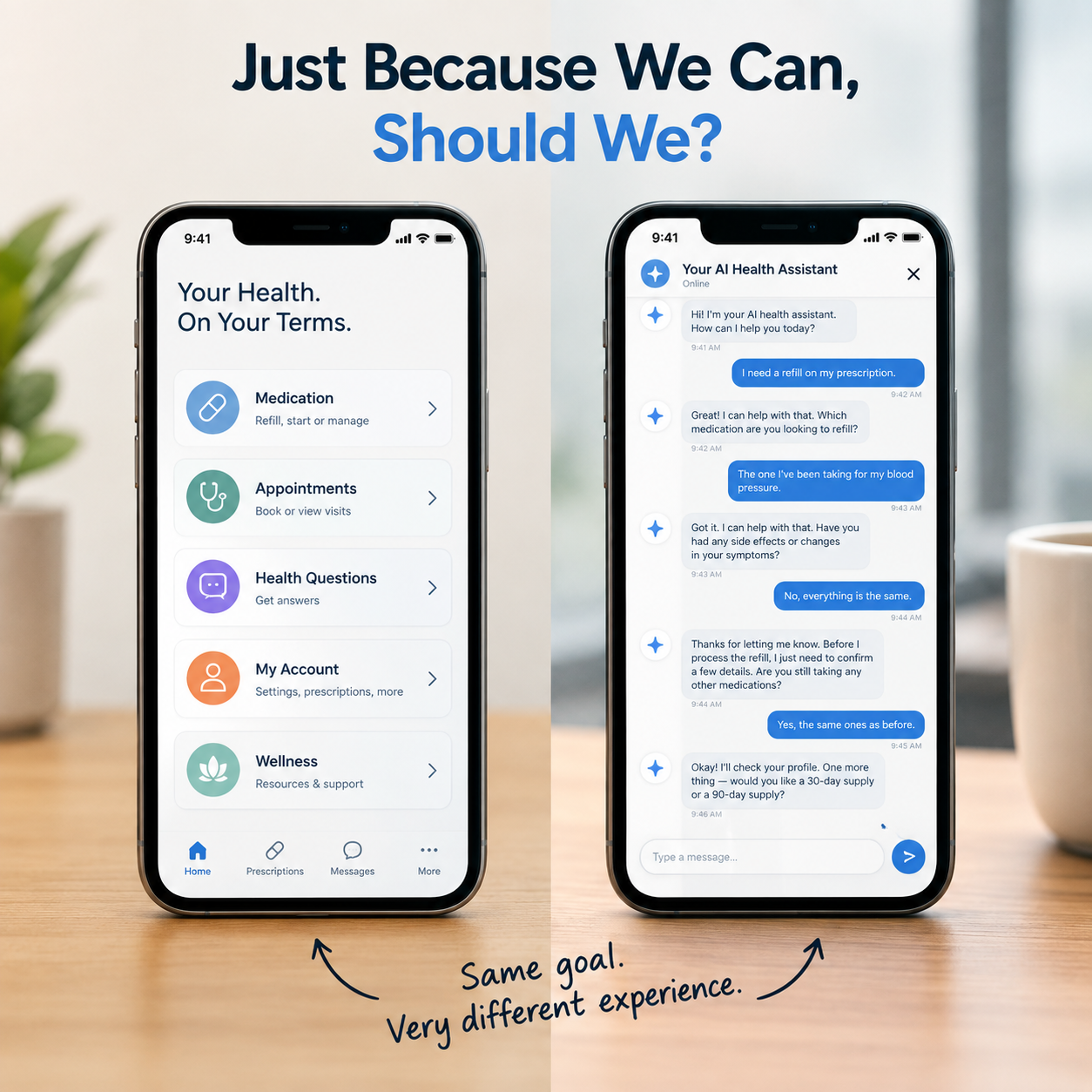

This morning, I opened up the Hims app that I frequently use. I anticipated what I’ve come to expect from it: A functional digital experience where I could find what I needed, navigate to the appropriate topic, and get on with my day.
Instead, seemingly overnight, the app experience had fundamentally changed (and was not in any way synced with the web experience — not even the support messages). The familiar, topic-by-topic interface had been replaced by something that felt much more like one continuous AI conversation.
And my immediate reaction was surprisingly simple: I hated it.
Not because I hate AI. Quite the opposite.
I spend a lot of time thinking about AI, writing about it, working on AI platforms and with organizations trying to figure out what it means for their businesses and their customers.
But this was a useful reminder of something I think marketers are in danger of forgetting: AI is a tool. It isn’t the customer experience.
Somewhere along the way, we’ve started confusing adding AI with improving the experience. And they are not the same thing.
There is an understandable rush happening right now. Every organization is asking the same questions:
- Where can we deploy AI?
- How can we make our experience more AI-powered?
- How can we get customers talking to our AI?
Those are reasonable questions. But perhaps the more important question is: What does the customer actually want?
Sometimes they want a conversation. Sometimes they want an answer. Sometimes they want a recommendation. And sometimes they just want to click the damn button and move on. That’s particularly important in healthcare.
When I’m looking for information about a health issue, medication, treatment or appointment, I don’t necessarily want to have a conversation with an AI. I may already know exactly what I’m looking for.
Give me the information. Give me the choices. Let me navigate. Let me make a decision.
The irony is that marketers have spent decades trying to remove friction from digital experiences. We simplified navigation. We reduced clicks. We organized information around what users actually wanted to accomplish.
Now we’re potentially introducing a new kind of friction because we’re so eager to demonstrate that we’ve incorporated AI.
And here’s the thing: Conversation isn’t inherently intuitive. Humans are conversational. That doesn’t mean every digital experience should be.
Imagine walking into a grocery store and having someone stop you at the entrance and say: “Hi! Tell me what you’re looking for today.”
Maybe that’s helpful. But maybe you just want to walk down aisle seven and grab toothpaste.
There’s something else happening here, too: AI can create the illusion of personalization while actually reducing customer control.
A well-designed interface lets me see what’s available. It gives me context. It lets me compare things. It allows me to move backward, forward or sideways.
A conversational interface can make me dependent on the system to determine what information I see and what questions I should ask next. That’s a significant shift and marketers should be thinking very carefully about it.
I’m not suggesting we resist AI. Quite the opposite. There are extraordinary opportunities to use AI to make customer experiences more responsive, accessible, personalized and useful.
But perhaps the goal shouldn’t be to make everything AI. Maybe the goal is to make the experience better. Sometimes that means an AI assistant. Sometimes it means predictive recommendations. Sometimes it means a smarter search function. And sometimes it means leaving the damn interface alone because it already works.
The best use of AI may ultimately be the one customers barely notice, because customers don’t care how much AI your company has. They care whether you helped them accomplish what they came to accomplish.
Don’t AI your customer experience because you can. Use AI where it creates genuine value. And remember something marketers have understood for a very long time:
The technology is not the experience. The customer is.