


From Walter Cronkite’s evening broadcast to AI chat interfaces — how the collapse of the information monolith reshaped consumer behavior, brand reputation, and what it means to be believed.
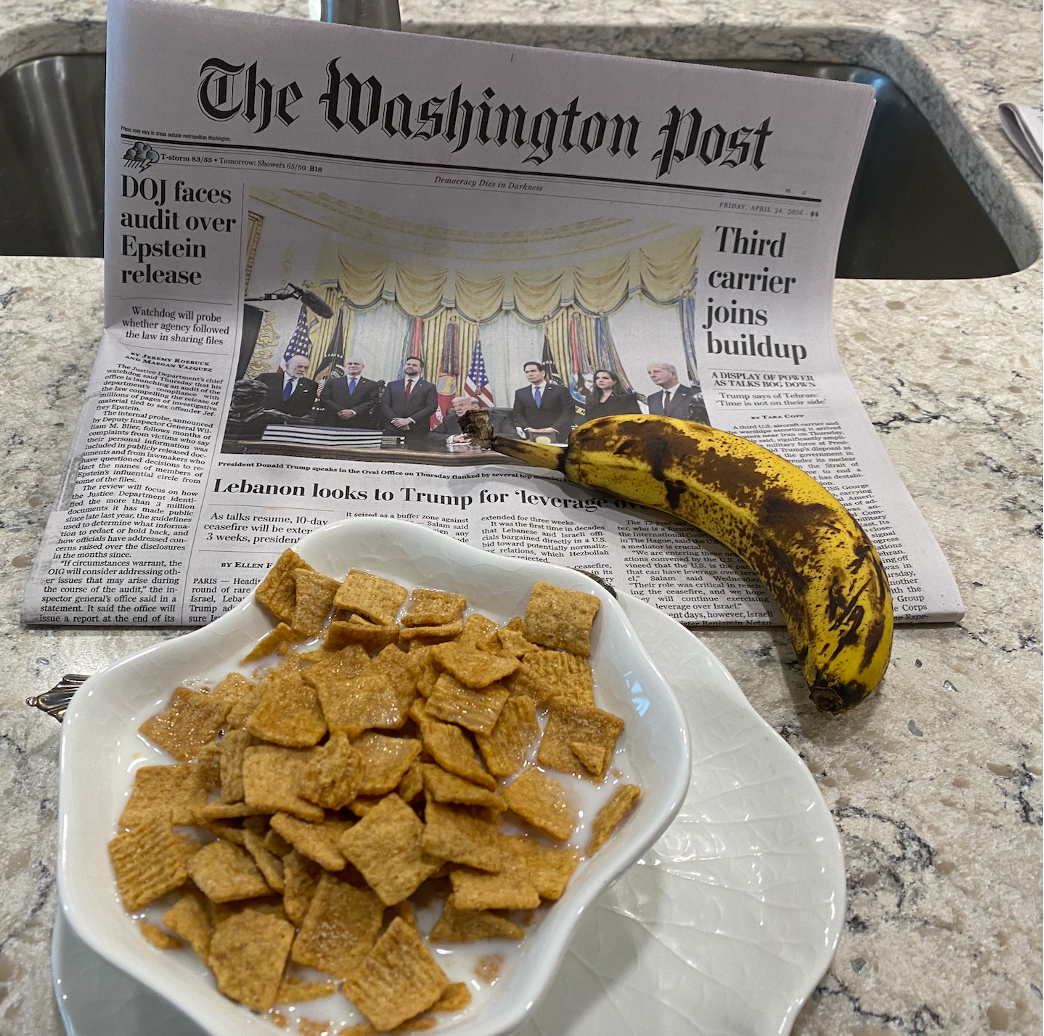
My father Richard was reading my new book The Death of Compromise, and noted a reminiscence I had discussed about his media consumption. Each morning he would eat his cereal, an old banana and read The Washington Post. Then at night he’d watch Walter Cronkite on the CBS Evening News. So he sent me the photo above.
For him, the ritual is inseparable from the publication: The weight of the paper, the hierarchy of the front page, the sense that someone had already filtered the world’s chaos into something worth knowing.
He grew up in an era when Walter Cronkite’s sign-off, “And that’s the way it is,” was not a claim. It was a social contract. Information moved slowly, through gatekeepers with credentials, editors with standards, and anchors whose gravitas was itself a form of institutional authority. Consumers didn’t choose their news feeds. The feeds chose them.
For marketers, that world was paradise, sort of. Reach was finite. Trust was inherited. Repetition was enough. If a brand appeared beside the right anchor or in the right column, prestige transferred automatically.
But that world is gone. And understanding exactly how it ended, and what replaced it, is the most important strategic exercise a modern brand can undertake.
Consider this reality:
- The Big 3: In 1970, ABC, CBS, and NBC commanded over 90% of American primetime television viewership. A single ad buy could reach virtually every household. Fragmentation was not yet a concept marketers needed to fear.
- The 72% Mark: That was Gallup’s peak recorded trust in mass media, achieved in 1976. By 2024, that figure had fallen to roughly 31%. The institutions didn’t just lose eyeballs. They lost the presumption of credibility that once made them worth watching.
- What to Believe: There is no meaningful upper bound on today’s information supply. Podcasts, newsletters, social feeds, AI assistants, Reddit threads, and Discord communities all compete for the same finite resource: A consumer’s willingness to believe.
Act I: The Great Fragmentation: Monoliths to Mosaics
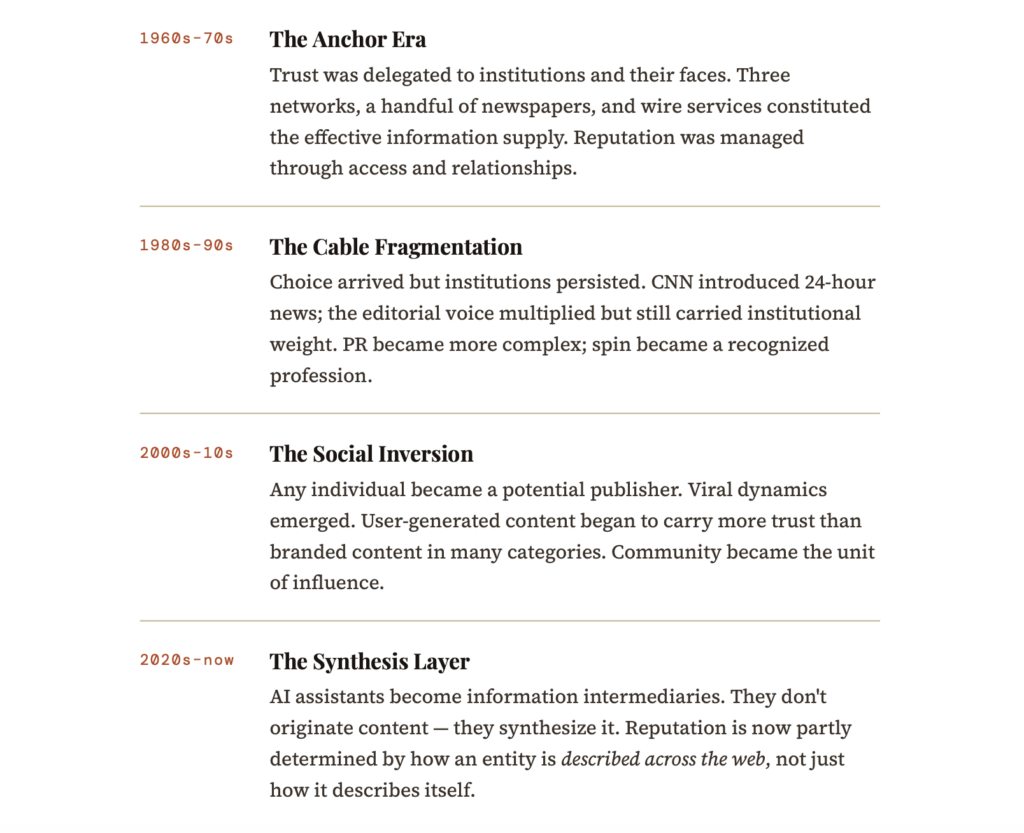
The shift didn’t happen overnight. It happened in layers. Cable news in the 1980s introduced the first heresy: There could be more than one authoritative voice, and that viewers might choose one based on something other than objective quality. Then came the internet, which didn’t just add more channels. Instead, it dissolved the channel concept entirely.
The consumer who once had three evening news choices now curates a personal information ecosystem made of dozens of sources, most of which are completely invisible to the brands trying to reach them. A 45-year-old in Phoenix might trust a financial newsletter with 30,000 subscribers more than The Wall Street Journal. A 28-year-old in Brooklyn might form her opinions on a product from a Reddit thread, a TikTok creator, and a Substack writer she’s never met but considers a close acquaintance.
For marketing, this changes everything about the concept of reach. Reach without relevance is noise. And in a fragmented landscape, relevance is hyper-local, hyper-personal, and hyper-contextual.
The Washington Post still exists. The man at the kitchen counter still reads it. But his information stream is one of millions. And the brands that assume their audience resembles his habits are operating from a map drawn for a different territory.
Act II: Reputation Shaped By Speed, Volume and Veto
In Cronkite’s era, a brand’s reputation was shaped by advertising, public relations, and the occasional crisis handled behind closed doors. The feedback loop was slow. A negative newspaper story might be countered with a corrective press release and a quarter-page ad. The consumer had limited recourse and even more limited amplification.
Today, any consumer with a phone has more potential reach than most brands had with their entire advertising budgets two decades ago. A single viral post can incinerate a reputation that took decades to build. A grassroots campaign organized in a Slack channel can drive a boycott that reshapes a company’s supply chain.
This is not simply an acceleration of the old model. It is a structural inversion. Reputation is now bottom-up as much as it is top-down. Brands do not simply broadcast their values — they are evaluated against them, constantly, in public, by audiences who compare notes in real time.
The marketer’s instinct to control the message has become almost comically insufficient. The message is now a conversation, and conversations cannot be controlled — only influenced, responded to, and shaped by the quality of the organization behind the brand.
What this means practically: reputation is now a live operational performance, not a communications output. The behavior of a company’s customer service team, its response to a supply chain scandal, its internal culture as leaked by employees — these are brand messages, whether the brand intends them to be or not.
The brands that understand this don’t try to wall off operations from communications. They treat every internal decision as a potential public communication, because under sufficient scrutiny, it will become one.
Act III: The AI Wildcard of an Intermediary with No Agenda
Every information intermediary in history has had an agenda — not necessarily sinister, but structural. Editors decide what’s newsworthy based on their conception of the audience. Algorithms optimize for engagement. Influencers are motivated by relationships with brands, even when they disclose them. Even the most trusted human voices are filtering the world through their own perspectives, incentives, and blind spots.
AI assistants introduce something genuinely new: an intermediary that synthesizes information from vast sources without a point of view it’s trying to protect, an audience it’s trying to build, or an advertiser it’s trying to please. This is not the same as being objective — AI systems carry the biases of their training data and the values of their designers — but the structure of the relationship between user and AI is unlike anything that has come before.
When someone asks an AI assistant whether a medication is safe, or which car has the best safety rating, or whether a financial product is worth the fee — they are asking a question they might once have asked a trusted expert, a doctor, a financial advisor. The AI’s answer doesn’t come with a referral fee. It isn’t shaped by which pharmaceutical company runs ads in the publication. It doesn’t have a personal relationship with the brand.
For marketers, this is a profound reckoning. The old game of securing favorable placement in influential media still matters — but AI systems are increasingly the synthesis layer through which consumers process media. A brand might earn excellent press coverage, only to find that when a user asks an AI assistant for a recommendation, the synthesis of available information produces something more nuanced, more critical, or more comparative than any single article would have.
Five Imperatives for the Multi-Stream Age
1. Map the Actual Stream, Not the Assumed One
Your audience is not consuming media the way your media plan assumes. Invest in genuine ethnographic research: how do your best customers actually find information? Where do they go when they have a question in your category? The answer will surprise you, and it will reorder your priorities.
2. Build for Synthesis, Not Just for Placement
Every piece of content you create, every review you earn, every forum thread you participate in becomes raw material for AI synthesis. Stop thinking in terms of individual placements and start thinking about the cumulative information footprint your brand creates across the entire web.
3. Earn the Habit Premium
The most valuable brand relationships exist where customers don’t make a choice — they simply reach for what’s there, like the man reaching for his newspaper. Newsletter subscriptions, loyalty rituals, morning routines: find the moment your product belongs in and make it indispensable to it.
4. Treat Operations as Communications
In the multi-stream age, everything is eventually visible. Your return policy, your customer service response time, your internal culture — these are brand communications, whether or not they go through your communications team. Align operations with brand values before the internet aligns them for you.
5. Pursue Trust as a Business Metric
Awareness, reach, and engagement are lagging indicators of trust. Track trust directly: net promoter scores, independent review sentiment, AI representation audits. The brands that will dominate the next decade are those that treat trust as a balance sheet item, not a communications byproduct.
Respect the Value of Ritual
Generations of media consumption have trained consumers to trust sources embedded in their daily rhythm. Brands that insert themselves into existing rituals — rather than simply interrupting them with advertising — access a fundamentally different quality of attention. The goal is not to be seen. It is to be relied upon.
What Matters at the End of the Day
In the Cronkite era, earned media — what traditionally practiced PR worked to achieve — meant getting quoted in the right paper. Today, it means being described accurately and positively across a sufficiently large and diverse set of sources that any AI synthesis reflects your best truth. This is not a communications strategy. It is an operational one.
The man at the kitchen counter — my old man — has not made an irrational choice. He has found a source he trusts and built a life around it. There is wisdom in that, not nostalgia. The lesson for modern marketers is not to mourn the lost simplicity of three networks and one newspaper. It is to understand what made those sources worth trusting in the first place: consistency, accountability, depth, and a genuine commitment to the reader’s interest over the publisher’s convenience.
Those qualities are still what earn trust. That is in any medium, in any era, from any audience. They always were. The delivery mechanism changes. The standard doesn’t.
Your brand is a media company now, whether it wants to be or not. The question is what kind of media company it will be — and whether, fifty years from now, someone will still reach for it out of habit, the way a man reaches for his newspaper over breakfast.