

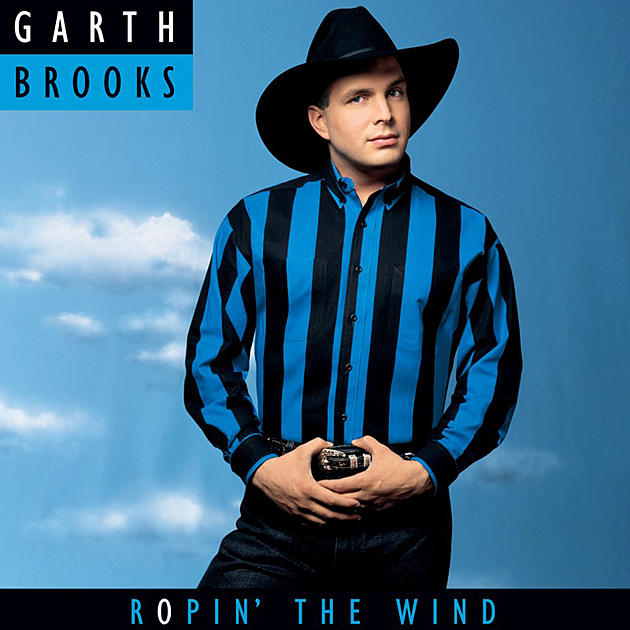

In the 1990s, like many white men in my 20s, I listened to a lot of Garth Brooks. At the time, he wasn’t just the biggest name in country music—he was arguably the biggest name in music, period. He was the ’90s version of Taylor Swift. Brook’s Ropin’ the Wind became the first album ever to debut at number one on both the country and pop charts simultaneously. He sold out stadiums the way other artists sold out clubs. He was, by any reasonable measure, a phenomenon.
I was putting together a 1990s country playlist on Apple Music this weekend and some of my favorites by Brooks like “That Summer”—actually, the entirety of his catalogue—was unavailable to include. And it dawned on me: How did the most dominant musical brand of an entire generation become almost completely invisible?
The answer isn’t scandal. It isn’t a bad album or a bad decision (minus that God-awful Chris Gains thing when Garth lost his mind). It’s something far more instructive for anyone who manages a brand, a business or a reputation: Garth Brooks chose to disappear—and the market was perfectly happy to move on without him.
SILENCE IS A VACANCY SIGN
In marketing, silence is not a strategy. Silence is a vacancy sign.
For years, Brooks famously withheld his catalog from streaming platforms. While Taylor Swift was locked in headline-generating battles over music ownership and Beyoncé was engineering cultural moments on demand, Brooks simply…well…he wasn’t there. He wasn’t on Spotify. He wasn’t on Apple Music. He wasn’t in the algorithms, the playlists, the recommendation engine, or the conversation. He launched his own streaming service—GhostTunes, later replaced by a platform called Sevens. It was a move that, viewed generously, was ahead of its time. Viewed more honestly, it was a walled garden nobody wanted to visit.
For modern-day country music fans, the streaming generation didn’t discover Brooks. They discovered Morgan Wallen, Zach Bryan, Beyoncé’s country era, and unfortunately, Florida-Georgia Line. Hell, they found David Allen Coe and he can’t even spell streaming.
Music fans found the artists who showed up where the audience already was. It’s why you don’t put your fast-food restaurant location five miles out of town. You put it at the same intersection as McDonald’s and Taco Bell.
This is the core lesson that every brand manager should tattoo somewhere visible: You do not get to opt out of the conversation and then rejoin it on your own terms. Markets don’t hold your place in line. Attention flows to whoever is standing in the room, and the room today is digital, streaming, algorithmic, and relentless.
A LESSON IN CASH
Brooks has since tried to creep back. His catalog appeared on Amazon Music in 2016—a limited arrangement that felt less like a strategy and more like a concession. He also has “The Garth Channel” for free on TuneIn, which no one has ever heard of. But timing matters enormously in brand positioning. When you arrive late to a party, you don’t get to act like the guest of honor. You get a handshake and a, “Oh right, good to see you.”
Compare this to how Johnny Cash was handled after his death.
Rick Rubin’s American Recordings series didn’t just keep Cash culturally relevant. It made him more compelling in death than many living artists. Cash’s cover of “Hurt” introduced him to an entirely new generation. That’s brand stewardship. That’s understanding that an audience doesn’t owe you loyalty across a gap in presence.
Clearly, Garth Brooks has no Rick Rubin (but he does have better hair and wear shoes). Brooks has a philosophy that felt more like pride than strategy—that he would die a rich man whether he ever worked another day in his life, and thus, his music was too valuable to be commoditized at $9.99 a month alongside everyone else. What Brooks didn’t account for is that the alternative to being in the stream isn’t dignity. It’s silence.
And silence, in marketing terms, is indistinguishable from irrelevance.
THE MARKET OWES YOU NOTHING
There’s a version of this story where Brooks is admired for his convictions. And I’ll grant it: There is something almost noble about an artist who refuses to reduce his life’s work to a fraction of a cent per play. But nobility doesn’t move the needle. Presence does. Relevance does. The brands that endure in music, in business, in any competitive space—those are the ones that maintain a continuous relationship with their audience, even during the quiet seasons.
Michael Jordan retired twice and came back both times to a world that had saved his seat. But Jordan’s brand never went dark. The highlight reels stayed in rotation. The shoes kept selling. The conversation never stopped. Garth Brooks, by contrast, went quiet and expected the world to wait. It didn’t.
I still love ‘That Summer.” I have great memories of my friend Missy Harrison and me dancing to it at the Kapp Sig house in college. I think “Friends in Low Places” is one of the great communal sing-along moments in the history of American music. But when I want to feel nostalgic for 1990s country, my first instinct isn’t to navigate to wherever Garth’s catalog lives this week. It’s to pull up a playlist that an algorithm built for me — and Garth usually isn’t on it.
That’s not a tragedy. It’s a case study. And the lesson is simple enough to fit on a Post-it note: Show up, stay visible, or accept that someone else will fill the space you left behind.
The market is not sentimental. It never was.