

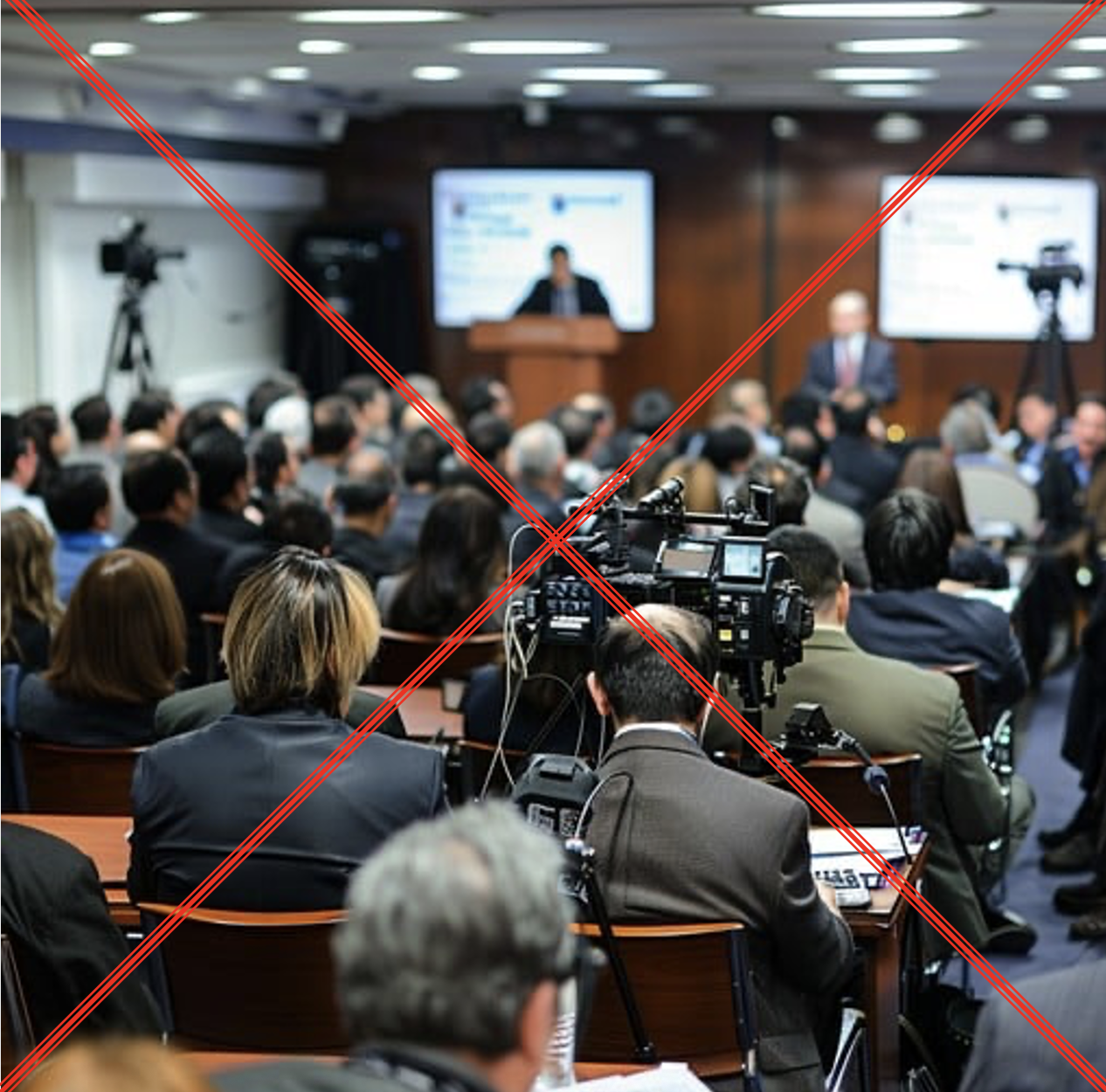

For decades, the press conference was a cornerstone of public relations and brand reputation management strategy. I should know. I’ve practiced PR since the 1920s or so. When organizations had news to share—whether a product launch, policy initiative, or leadership announcement—they gathered reporters in a room, delivered prepared remarks and opened the floor for questions.
Rinse, wash, repeat.
The format made sense in an era when journalists served as the primary gatekeepers between institutions and the public. If you wanted coverage, you needed the press physically present.
Today, that logic is increasingly outdated—and often it’s hard to move people away from having them.
Across industries, the traditional press conference is becoming less necessary. It’s certainly not obsolete, but no longer the default. The shift reflects profound changes in media economics, newsroom operations and the way information moves. Newsrooms have shrunk dramatically over the past two decades, leaving fewer reporters to cover more beats. Beginning in the early 2000s, many journalists began juggling multiple responsibilities and had to prioritize efficiency above all else. Attending a scheduled event, traveling across town and waiting through prepared remarks is often less appealing than receiving a concise pitch, an embargoed release or a quick one-on-one interview.
At the same time, journalism has become fundamentally digital-first. Reporters are expected to publish quickly and continuously, often within minutes of receiving new information. I have friends in journalism who are absolutely drowning as a result. Pre-packaged materials such as fact sheets, video clips, data visualizations and quotes fit neatly into this workflow. A press conference, by contrast, can dramatically slow things down. By the time the event concludes, the story may already be written based on distributed materials. In many cases, the conference itself adds little incremental value.
Perhaps the most significant shift is the rise of direct communication. Organizations no longer rely exclusively on journalists to reach their audiences. They can livestream announcements, publish statements on social media, release polished videos, and distribute content directly to stakeholders. This disintermediation has altered the fundamental purpose of press conferences. When the public can hear the message straight from the source, the need to convene reporters in a room diminishes.
There is also an optics challenge.
Many press conferences today feel staged or performative, especially when they lack substantive news. Reporters have grown more skeptical of events that appear designed primarily for visuals rather than information. When journalists suspect they are being asked to attend something that could have been an email, attendance declines—and with it, the return on investment.
But rest assured, none of this means press conferences have lost all relevance. Indeed, they remain valuable in specific contexts such as breaking news with public safety implications, crisis situations requiring accountability, major government announcements, complex data releases, or moments when live questioning itself becomes part of the story. In those cases, the transparency and immediacy of a press conference still carry weight.
But outside those scenarios, communicators are increasingly turning to alternatives that better match modern media realities. Small-group briefings, virtual sessions, embargoed releases, exclusive interviews, and on-demand video announcements often generate more coverage with less friction. These approaches respect reporters’ time while delivering information in formats that align with how news is produced today.
The press conference has not disappeared, but its role has dramatically narrowed. What was once the default tactic is now a specialized tool that is best deployed when the moment truly calls for it. In an era defined by speed, fragmentation, and direct communication—the most effective public relations strategies prioritize flexibility over tradition.
And for many announcements, that means leaving the podium behind.