


Welcome to the Content Singularity
If you’ve spent any time in marketing lately, you’ve probably felt that queasy sensation of the ground shifting beneath your feet. It’s not just you. Generative AI isn’t knocking at the door anymore; it’s moved in, rearranged the furniture and is currently raiding your refrigerator.
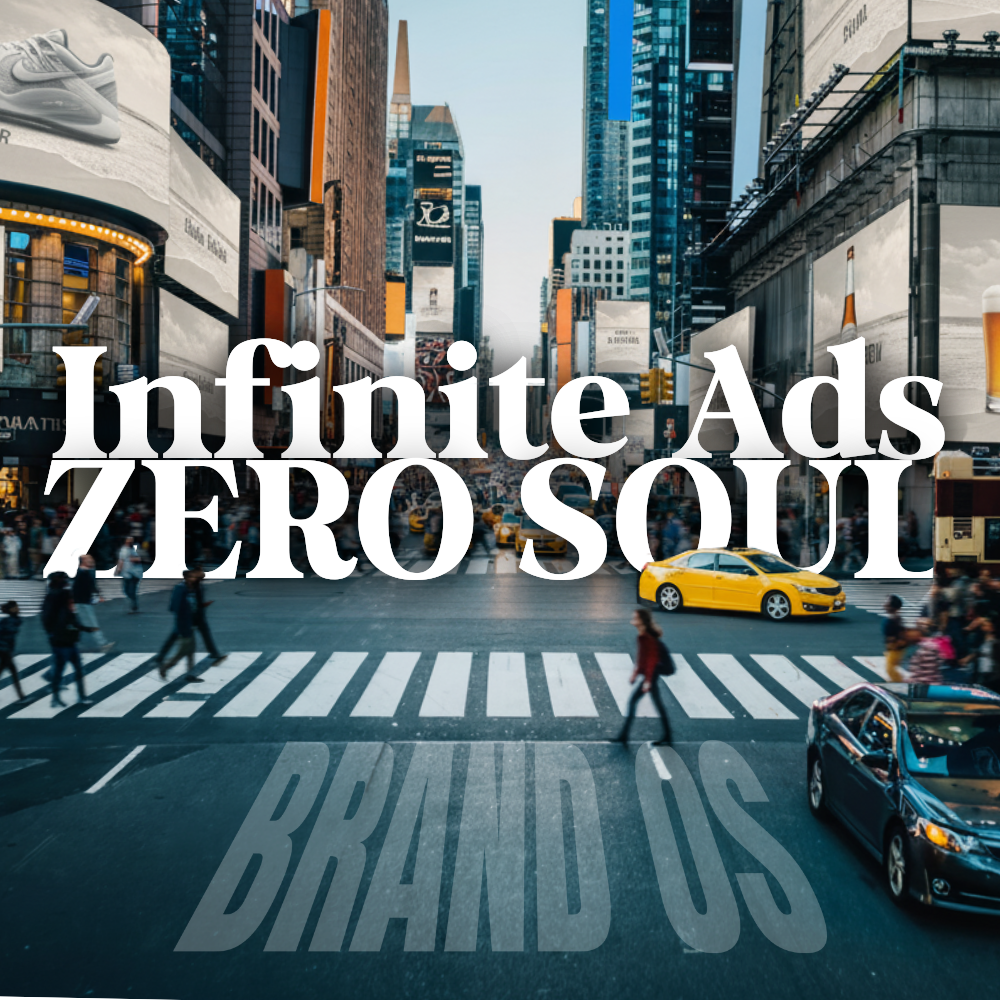
Meta announced they want every business to upload their product catalog, type in some basic copy, and let the machines spit out infinite ad variations. Infinite! As if what the world was missing was more ads.
This promise (or threat?) of infinite content is exactly why I’m writing this series on the importance of brand foundations in an increasingly AI-driven marketing world.
Because here’s the rub: when everyone can generate unlimited variations of the same vanilla ideas at the speed of thought, being different isn’t a competitive advantage, it’s a requirement. Over the next few weeks, I’ll unpack why branding is your most critical operating system in this brave new world, how to keep your marketing from dissolving into algorithmic soup, and how to turn AI from a brand-flattening bulldozer into a differentiation amplifier.
The Mirage of More
Marketers have always been addicted to scale. More ads. More posts. More everything. AI feels like mainlining pure productivity. It can generate content faster than legal can reject it. But here’s the dirty secret nobody wants to admit:
AI doesn’t know what makes you special. It only knows how to remix what already exists.
Without a rock-solid brand foundation, your AI-generated ads will sound exactly like your competitor’s AI-generated ads, which sound exactly like that other company’s AI-generated ads. It’s turtles all the way down, except the turtles are all wearing the same “innovative, trusted, reliable” shell.
Before you write me off as another creative trying to “fight progress,” there’s data to back this up. According to the updated NCS study, creative quality (not targeting wizardry or reach) drives nearly half of advertising’s effectiveness. Meanwhile, brands that maintain consistency see a 23% revenue lift on average. Translation: If you’re feeding AI generic brand pudding, all you’re doing is mass-producing mediocrity at unprecedented velocity.
Enter the Brand Operating System
The solution isn’t to succumb to scale and throw in the towel – It’s to make sure you can give your tools something worth amplifying: a Brand OS.
Think of your Brand OS as the firmware that ensures every piece of content actually looks, feels and sounds like you, whether crafted by a strategist, a copywriter, or a particularly clever algorithm.
Here’s what your OS needs to not suck:
1. A Position That Actually Positions
AI can’t tell you what your brand stands for. That’s like asking ChatGPT to explain your childhood trauma. Sure, it’ll give you something that sounds right but misses the specifics. AI might be smart enough to guess your tendency to buck authority came from the lack of a father-figure but wouldn’t know that your Dad left to get milk in January before that big ice storm, in his ‘95 Dodge Neon and then never came back. See the difference?
Take Healthy Paws Pet Insurance. Their position? “Protected. Like Family.” Three words that inform everything from CTV spots to TikToks. When we test AI tools for content scaling, those three words keep the brand from drifting into the sea of sameness where every pet insurance company is “caring” and “affordable.”
2. A Voice That Doesn’t Sound Like It Was Written by Committee (or Worse, AI)
Generative AI is only as distinctive as the rules you feed it. Your Brand OS needs specific, battle-tested voice guidelines. It does NOT need to “be conversational” but “sound like the friend who actually reads the instructions but makes fun of them while doing it.”
For a national infrastructure client, we built distinct messaging tracks: plainspoken clarity for policymakers, visionary boldness for investors. When AI entered the picture, it had lanes to stay in. It could improvise without turning everything into corporate word salad (which really is the least filling of all salads).
3. Guardrails (Because AI is a Toddler with a Flamethrower)
Remember Google’s AI Overview suggesting people put glue on pizza? That’s what happens when you let the machines run wild. Your brand can’t afford to be the next screenshot making rounds on LinkedIn with cry-laughing emojis.
For a global tech brand prepping for launch, we built human checkpoints for every AI-touched campaign. Not because we’re Luddites, but because “move fast and break things” hits different when the thing breaking is your brand’s reputation.
4. Consistency That Actually Sticks
Research on Distinctive Brand Assets is sobering: fewer than 15% of logos, colors, or taglines are genuinely unique. That means if you’re not fiercely protecting what makes you different, AI will happily smooth those edges until you’re perfectly, and forgettably, round.
Missouri Wines gets this. Their “Worth the Work” campaign has DNA that survives any execution, human or machine-made. The brand codes stay intact whether we’re shooting with a photographer for a unique view of an authentic Missouri winery or prompting Nano Banana to update a cozy indoor scene. That’s not an accident. That’s architecture.
The Uncomfortable Truth
Here’s what keeps me up at night: We’re about to see a tsunami of AI-generated content that makes everything look and sound the same. Brands without a strong OS will drown in their own generic output. But those with solid foundations? They’ll use these same tools to move faster and hit harder than ever before.
Three things to tattoo on your forehead (or at least your monitor):
More ads ≠ more impact. Distinctive creative, not content velocity, drives results. Testing and scale can be game changers, but not at the expense of insight-driven creative that is truly on-brand.
AI is a multiplier, not a strategist. It amplifies what you feed it. If you feed it nothing, well, that’s a good estimate of your brand lift and ROAS.
Brand guidelines aren’t bureaucracy. Well-structured, detailed and thoughtful guidelines are what keep you from becoming a carbon copy of your more successful competition.
At Elasticity, we believe brand is the ultimate operating system. It’s what lets you scale faster, smarter and safer in a world where any competitor can spin up infinite ads before their morning coffee gets cold.
If you’re wondering whether your Brand OS is strong enough for today’s marketing climate, let’s talk. Email me at nick@goelastic.com to learn more about our brand workshops and audits that can help you build and position your brand for success.